
Want to create your own premium-looking brand without hiring a designer or spending weeks learning design software? Here's a practical way to turn your business idea into a professional identity, a beautiful website, and consistent marketing visuals—in a single afternoon.
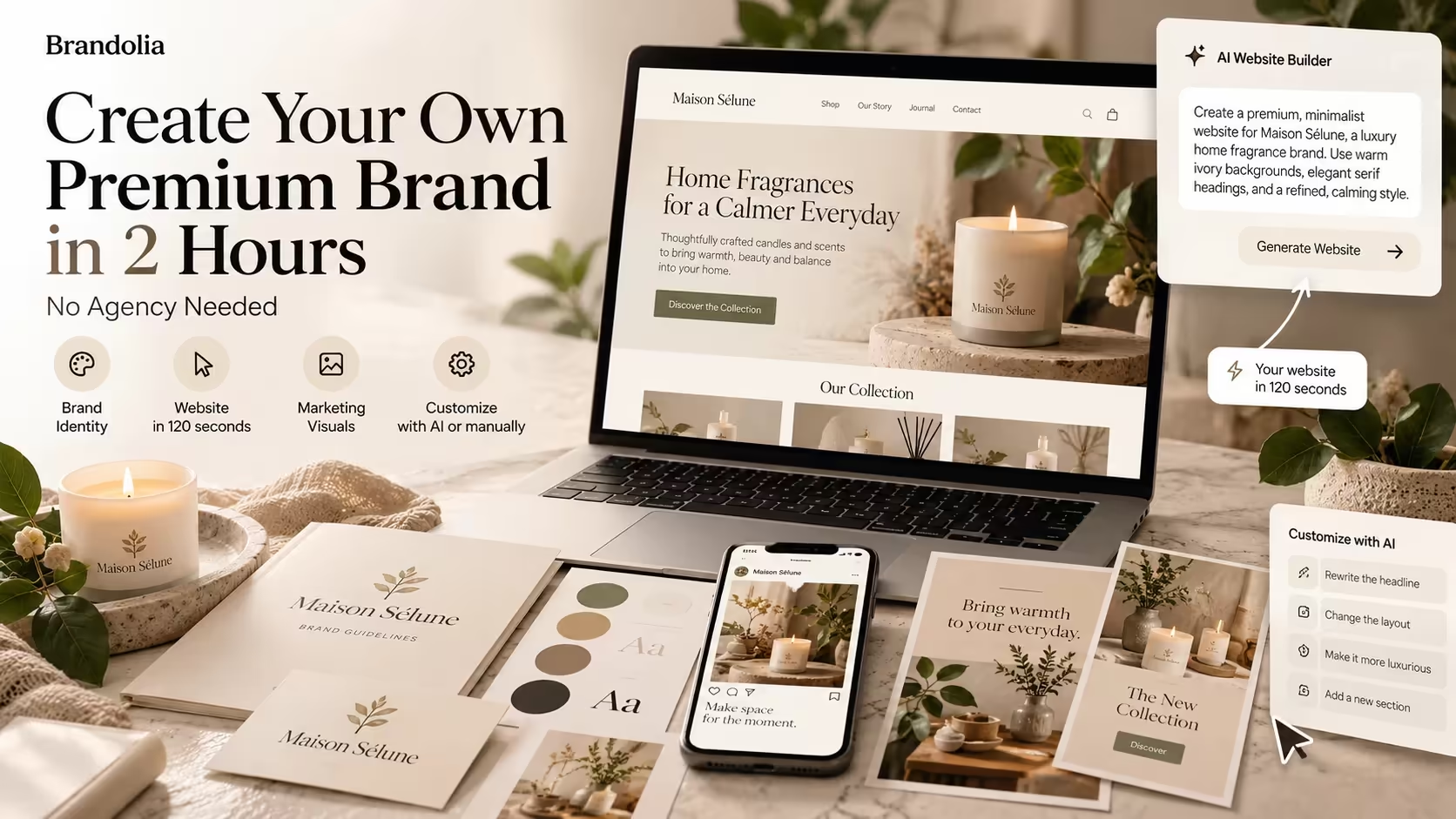
Table of Contents
- What Makes a Brand Look Premium?
- The 2-Hour Premium Branding Framework
- Step 1: Define Your Brand Positioning (15 Minutes)
- Step 2: Create a Premium Visual Identity (25 Minutes)
- Step 3: Create a Brand Voice That Feels Professional (15 Minutes)
- Step 4: Create a Premium Website in 120 Seconds With AI, Then Make It Yours
- Step 5: Create Marketing Visuals That Match Your Brand (20 Minutes)
- Step 6: Review Your Brand Like a Creative Director (15 Minutes)
- DIY Branding vs. Hiring a Branding Agency: Which Is Right for You?
- Can You Really Create a Premium Brand in Two Hours?
- Frequently Asked Questions
- Final Thoughts: Your Business Deserves a Brand That Reflects Your Vision
Starting a business is exciting. Building a brand that actually looks professional? That's where many entrepreneurs get stuck.
You have the idea. You know what you want to sell. You might even have a name.
But then come the questions.
What colors should you use? Which fonts look professional? How do you build a beautiful website? How can you make your Instagram, website, and marketing materials look like they belong to the same company?
Traditionally, answering those questions meant hiring a branding agency, working with multiple freelancers, or spending hours learning design tools.
Today, there's another way.
You can create the foundations of a premium-looking brand yourself, even without professional design experience.
With a clear strategy, a simple visual system, and modern AI-powered branding tools, you can develop a coordinated brand identity and its first digital assets much faster than before.
Quick answer: How do you create a premium brand yourself?
To create your own premium-looking brand, start by defining your audience and positioning. Choose a consistent visual identity with complementary colors, typography, and imagery. Develop a recognizable brand voice, build a professional website, and apply the same identity across your marketing materials.
AI branding platforms such as Brandolia can help accelerate this process by bringing brand identity creation, website generation, and marketing visuals into a single workflow.
The key isn't making everything look expensive.
It's making everything feel intentional, consistent, and unmistakably yours.
In this guide, we'll walk through a six-step framework you can use to create your brand's first professional identity in approximately two hours.
What Makes a Brand Look Premium?
Before creating anything, it's worth understanding what premium branding actually means.
A premium brand is not simply a business with an elegant logo or expensive-looking website.
It's a business that communicates quality through its identity, positioning, and customer experience.
Think about how a high-end skincare company, boutique hotel, or modern consulting firm presents itself.
The strongest brands share several characteristics.
1. A clear identity
You can quickly understand what the business represents and who it serves.
Its personality feels deliberate rather than generic.
2. A consistent visual language
The same colors, typography, design principles, and imagery appear across the website, social media, and marketing materials.
3. Simplicity and confidence
Premium brands often avoid unnecessary visual noise.
They favor clear messages, balanced layouts, carefully chosen imagery, and thoughtful use of space.
4. Attention to detail
Typography, spacing, mobile responsiveness, product photography, and even button design influence how professional a brand feels.
5. A credible brand promise
A premium appearance needs to be supported by a compelling product, a clear value proposition, and a reliable customer experience.
This is an important distinction: you can build a premium-looking identity quickly, but a genuinely premium reputation develops through the value you deliver over time.
The goal isn't to imitate luxury brands. It's to create an identity that looks appropriate, credible, and distinctive for your audience.
The 2-Hour Premium Branding Framework
You don't need months to develop the first version of your brand identity.
Here's how to structure a focused two-hour branding session.
| Step | What you'll create | Time |
|---|---|---|
| 1 | Brand positioning and personality | 15 min |
| 2 | Visual identity and brand kit | 25 min |
| 3 | Brand voice and messaging | 15 min |
| 4 | Website generation and customization | 30 min |
| 5 | Marketing visuals | 20 min |
| 6 | Final review and refinement | 15 min |
| Total | Your first complete brand presentation | 120 min |
These times are a practical planning framework, not a guarantee. Your first working draft can be created quickly, but a full business launch may require additional research, testing, legal checks, and refinements.
Let's build an example brand along the way.
Step 1: Define Your Brand Positioning (15 Minutes)
The first step to creating a premium brand isn't choosing colors.
It's deciding what your business should represent.
Imagine you're launching a premium home fragrance brand.
For this guide, we'll use a fictional company called Maison Sélune.
Instead of simply describing it as a candle shop, let's give it a clear positioning:
"Thoughtfully designed home fragrances for people who appreciate quiet luxury and everyday rituals."
That one sentence already communicates a direction.
The brand should feel elegant, warm, calming, and understated.
This positioning will influence everything from its visual identity to its website.
Identify your ideal customer
Answer these questions:
- Who is most likely to buy your product?
- What does that person value?
- What alternatives are they already considering?
- Why would they choose your business?
- What emotions should your brand communicate?
Avoid defining your audience too broadly.
"A premium brand for everyone" is not useful positioning.
"A premium home fragrance brand for design-conscious people who appreciate minimalist interiors" gives you a much clearer direction.
Choose three brand personality traits
For Maison Sélune, we might select:
Refined. Warm. Minimal.
These three words become filters for every creative decision.
Whenever you choose a font, color, photograph, or website layout, ask whether it reflects those characteristics.
Write your brand positioning statement
Use this simple formula:
We help [target audience] achieve [desired result] through [your distinctive offer].
For example:
"We help design-conscious homeowners create calm, inviting spaces through thoughtfully crafted home fragrances."
You now have a foundation for your brand.
If you want a broader introduction to the complete process, explore this guide to building a brand with AI.
Your result: A defined target audience, positioning statement, and three personality traits.
Step 2: Create a Premium Visual Identity (25 Minutes)
Now that you know what your brand stands for, you can begin creating its visual identity.
A professional visual identity is more than a logo.
It's a coordinated system of colors, typography, imagery, and design elements that makes your business recognizable.
Start with a refined color palette
For Maison Sélune, imagine this palette:
| Color | HEX | Application |
|---|---|---|
| Warm Ivory | #F5F1E9 |
Main backgrounds |
| Charcoal | #242424 |
Headlines and text |
| Muted Olive | #858875 |
Supporting elements |
| Soft Taupe | #B7A99A |
Decorative accents |
These colors create a calm, understated aesthetic.
But premium doesn't always mean neutral colors.
A luxury-inspired fashion brand might use expressive, bold colors. A premium technology company might use a much more technical visual system.
Choose colors based on your audience and positioning.
Select typography that reflects your personality
Typography can dramatically change how a brand is perceived.
For Maison Sélune, we could combine:
- An elegant serif font for headings.
- A clean, readable sans-serif font for body text.
This creates contrast between expressive headlines and practical everyday content.
Avoid using too many fonts. Two complementary families are usually enough for a simple brand.
Create a recognizable visual signature
Your visual signature could be a distinctive wordmark, monogram, simple symbol, or recurring graphic element.
It should work across different formats.
Ask yourself:
- Is it recognizable at small sizes?
- Does it work against light and dark backgrounds?
- Can I use it on packaging and social media?
- Does it reflect the brand's personality?
- Is it sufficiently different from competing businesses?
A complicated logo isn't necessarily more premium.
Sometimes a carefully designed wordmark is all you need.
Establish your art direction
Next, define the visual atmosphere of your brand.
For our fictional candle company:
Photography: Soft natural light, close-up product details, minimal backgrounds.
Layout: Generous whitespace and restrained composition.
Mood: Warm, calm, tactile, contemporary.
Graphics: Minimal decorative elements.
This visual direction should influence every asset you create afterward.
Bring the elements together
This is where an integrated branding platform can save time.
Rather than generating unrelated assets with several different tools, Brandolia's brand creation features help entrepreneurs develop logos, color palettes, typography, art direction, and brand guidelines around a shared identity.
The result is a visual system you can extend into your website and marketing materials.
Your result: A first brand kit containing your visual identity, colors, typography, and art direction.
Step 3: Create a Brand Voice That Feels Professional (15 Minutes)
A premium brand doesn't only need to look good.
It also needs to sound consistent.
Your website headlines, product descriptions, emails, and social media captions should communicate with a recognizable personality.
Consider these two messages.
Generic:
"BUY OUR AMAZING PREMIUM CANDLES TODAY!"
More considered:
"Bring warmth and quiet beauty to the spaces you call home."
Both communicate a product.
But the second approach better reflects the calm, refined personality we've defined for Maison Sélune.
Define three rules for your brand voice
For our example:
- Use calm, confident language.
- Keep sentences clear and intentional.
- Focus on quality, atmosphere, and everyday rituals.
Now write the three essential elements of your brand messaging.
Tagline
"Make space for the moment."
Brand description
"Maison Sélune creates considered home fragrances designed to bring warmth, calm, and character into everyday spaces."
Call to action
"Discover the collection."
These elements will make creating your website significantly easier.
Instead of asking an AI website builder to invent your brand from nothing, you'll already have a clear voice and direction.
Your result: A tagline, brand description, primary call to action, and consistent tone of voice.
Step 4: Create a Premium Website in 120 Seconds With AI, Then Make It Yours
Your website is one of the most important expressions of your brand identity.
It's where your brand becomes a real experience.
Customers visit your website to understand your offer, explore your products or services, and decide whether they trust your business.
A beautiful website can make a strong first impression, but it also needs to be functional.
What makes a website look premium?
A professional, premium-looking website should include six essentials.
1. A strong visual identity
The website should use your established brand colors, fonts, logo, and imagery.
2. A clear hero section
Visitors should immediately understand what you offer and why it matters.
3. Thoughtful layouts
Balanced spacing, readable typography, and a clear visual hierarchy make the website easier to navigate.
4. Consistent messaging
Your headlines, product descriptions, and calls to action should reflect your brand personality.
5. Mobile-responsive design
Your website should provide a good experience on phones, tablets, and desktop screens.
6. Search-friendly structure
Clear headings, descriptive content, appropriate metadata, and logical navigation help visitors and search engines understand your website.
You don't need to be a professional web designer to work toward these standards.
And you no longer need to build every section manually.
How Brandolia creates your website from a single instruction
Brandolia takes the same brand-first approach to website creation.
Rather than forcing you to start from an empty page, it lets you describe the website you want and generates an initial website in one generation.
Brandolia's AI Website Builder is designed to generate a complete first website draft in approximately 120 seconds.
That initial generation can include:
- A coordinated layout and page sections.
- Headlines and supporting website copy.
- Brand-aligned typography and colors.
- Calls to action.
- Responsive design.
- SEO-oriented content structure.
Because Brandolia brings brand identity and website creation into the same platform, you can carry your visual direction into the website instead of rebuilding it across disconnected tools.
You describe your vision. AI creates the first version.
Then you refine it.
Example: Creating Maison Sélune's website
Imagine you want a beautiful website for our fictional candle brand.
You could start with this instruction:
Create a premium, minimalist website for Maison Sélune, a luxury-inspired home fragrance brand. Use warm ivory backgrounds, elegant serif headings, charcoal typography, subtle olive accents, and refined product imagery. Include a sophisticated hero section, featured collection, brand story, product benefits, and a clear call to action. The website should feel calm, editorial, and professional, with a responsive layout and clear navigation. Do not invent customer testimonials or product certifications.
This gives the AI a clear creative brief.
Instead of designing each section individually, the website is generated as a coordinated first draft.
You can then inspect the result and decide what to change.
This is an illustrative prompt, not a claim that this exact example has been generated or tested.
Customize your website by simply talking to AI
Here's where the process becomes especially useful.
You don't have to accept the first generated website as the final version.
With Brandolia, you can continue customizing it using natural-language instructions.
For example, you could ask:
Make the homepage feel more luxurious. Increase the whitespace, simplify the navigation, use a more elegant headline, and make the product imagery more prominent.
Or:
Rewrite the hero section to sound more refined and less promotional.
Or:
Add a section explaining the inspiration behind the collection, using the same visual style as the rest of the website.
The AI-assisted editing workflow lets you describe the changes you want instead of manually rebuilding everything.
This helps make website creation accessible to founders without coding experience.
Prefer full control? Edit your website manually
AI isn't the only way to customize your result.
Brandolia also lets you manually edit the generated website, like a traditional website builder.
You can use the manual editing experience to refine content and design directly, rather than relying on prompts for every adjustment.
This gives you two complementary ways of working.
| AI-assisted editing | Manual website editing |
|---|---|
| Describe the changes you want | Make changes directly |
| Generate alternative copy | Refine your text yourself |
| Request visual adjustments | Fine-tune the presentation |
| Explore new directions quickly | Exercise more precise creative control |
You can use AI when you want speed and manual editing when you want more control.
That combination is especially useful when you're creating a premium brand, where small visual decisions can make a meaningful difference.
One identity, from brand kit to website
The real advantage isn't simply generating a website quickly.
It's creating a website that feels connected to the rest of your brand.
Your website should use the same visual identity, tone, and creative direction as your marketing materials.
This is why an integrated branding workflow can be useful.
Instead of creating your identity in one tool, rebuilding it in a website builder, and recreating it again for social media, you can manage more of the process together.
If you're comparing integrated and separate tools, see this comparison of Brandolia with a Canva and Wix workflow.
Don't skip the final website checks
Even when AI generates a beautiful first draft, you should review it before launching.
Check that the website accurately describes your business, works across screen sizes, includes clear navigation, and has no broken links.
For accessibility, pay particular attention to text contrast. The W3C's WCAG guidance recommends a contrast ratio of at least 4.5:1 for most normal-sized text at Level AA.
You should also review page titles, headings, image descriptions, and internal navigation. Google's SEO Starter Guide explains the fundamentals.
An AI-generated SEO-ready website is a starting point, not a guarantee of search rankings or full accessibility compliance.
From idea to website: The workflow
- Describe your website. Explain your business, audience, design style, and desired content.
- Generate the first version. Brandolia creates an initial website in one generation, targeting approximately 120 seconds.
- Refine with AI. Describe changes to your content, layout, and creative direction.
- Customize manually. Use the website editor to make direct adjustments.
- Review and prepare to launch. Check branding consistency, content accuracy, responsiveness, and functionality.
Brandolia also offers HTML website export, with file download availability depending on the selected subscription.
You can check the current Brandolia plans and export options before deciding which plan fits your project.
Your result: A generated and personalized website draft that reflects your brand identity, ready for final checks and launch preparation.
Step 5: Create Marketing Visuals That Match Your Brand (20 Minutes)
You've defined your positioning, built a visual identity, developed your brand voice, and created your website.
Now you need to make the brand recognizable across your marketing.
This is where consistency becomes particularly important.
Imagine visiting a business's beautifully designed website, then discovering an Instagram account using completely different colors, typography, and graphics.
The two experiences feel disconnected.
To avoid this, extend your established brand identity into every marketing asset.
Start with three essential designs
For most early-stage businesses, three reusable formats are a good starting point.
A social media introduction
Create a post introducing your business and explaining what it offers.
A product or service showcase
Create a template you can reuse whenever you introduce an offering.
A promotional announcement
Create a recognizable layout for product launches, offers, or important news.
For Maison Sélune, these assets would use the same warm ivory, charcoal typography, restrained imagery, and calm brand voice as the website.
Create templates, not random designs
The aim isn't to generate a completely new design every time you publish.
Instead, establish a reusable system.
Your audience should recognize your brand even when the message changes.
AI-powered design tools can help generate marketing graphics, but the result becomes more valuable when those graphics follow the same visual identity.
That is the idea behind Brandolia's integrated marketing visual workflow: creating materials around your established brand direction rather than starting from scratch for every asset.
Your result: Three reusable marketing assets that look consistent with your website and brand identity.
Step 6: Review Your Brand Like a Creative Director (15 Minutes)
Before presenting your brand publicly, review everything together.
Open your identity kit, website, and marketing visuals side by side.
Don't review each element in isolation.
Ask yourself whether they feel like parts of one coherent business.
Your premium brand quality checklist
| Quality check | What to look for |
|---|---|
| Positioning | Is your offer clear to a first-time visitor? |
| Identity | Do the colors, typography, and visual style feel connected? |
| Consistency | Do the website and marketing assets look like the same brand? |
| Messaging | Does your copy sound natural, specific, and trustworthy? |
| Website | Is navigation clear and does it work on mobile? |
| Details | Are spacing, contrast, imagery, and buttons polished? |
| Credibility | Are your product claims accurate and verifiable? |
If something feels inconsistent, simplify it.
Remove unnecessary design elements. Fix awkward spacing. Replace generic headlines. Check the quality of your images.
Finally, review your brand name and visual identity for potential trademark conflicts.
For businesses operating in the United States, the USPTO trademark search guidance explains why checking potentially similar marks is important. Businesses elsewhere should consult the relevant national or regional trademark registers.
Your result: A coherent first brand presentation that you can confidently refine and introduce to potential customers.
DIY Branding vs. Hiring a Branding Agency: Which Is Right for You?
Creating your own brand isn't always better than hiring professionals.
The best approach depends on your business stage, complexity, and available resources.
| Consideration | DIY branding with AI | Branding agency |
|---|---|---|
| Starting cost | Usually lower | Typically higher |
| Speed to first draft | Often faster | Depends on project scope |
| Creative control | Direct founder involvement | Collaborative process |
| Strategic research | Founder-led | Can include specialist research |
| Custom design expertise | Depends on user and tools | Professional specialists |
| Best suited for | Early-stage brands, freelancers, small businesses | Complex brand systems, established businesses, large launches |
When creating your own brand makes sense
A DIY approach can be especially suitable when you're launching your first company, validating an idea, operating on a limited budget, or building a personal brand.
You can develop a coherent first identity without committing to a full agency project.
When hiring professionals makes sense
Specialist support can become particularly valuable for extensive market research, advanced packaging design, complex website requirements, detailed trademark considerations, or a major company rebrand.
The two approaches aren't mutually exclusive.
You can start by creating your own identity and later collaborate with specialists as your business grows.
A strong first version is often more useful than waiting indefinitely for a perfect one.
Can You Really Create a Premium Brand in Two Hours?
You can create the foundation of a premium-looking brand in a focused two-hour session.
That can include your positioning, visual identity, brand messaging, website draft, and initial marketing materials.
But it's important to distinguish creating a first brand identity from building a mature brand.
A successful premium brand also requires customer understanding, a compelling offer, consistent communication, and a quality experience over time.
Two hours can get your identity started.
What happens after launch determines how customers actually perceive your business.
The value of AI-assisted branding is that it helps reduce production time, so you can spend more energy refining your product, understanding your customers, and growing your business.
Frequently Asked Questions
How can I create a premium brand by myself?
Start with a clear brand positioning statement and target audience. Develop a consistent visual identity, choose complementary typography and colors, define your brand voice, and apply those elements to a professional website and marketing materials. AI-assisted branding tools can help accelerate the creative process.
Can I build my own brand without design experience?
Yes. You don't need professional design experience to create the first version of your brand. Understanding basic principles such as consistency, hierarchy, contrast, and clear communication will help you make better decisions. AI tools can assist with design production and website creation.
What makes a brand look expensive or premium?
Premium-looking brands tend to use consistent visual identities, intentional layouts, readable typography, distinctive imagery, and confident messaging. Their websites and marketing materials reinforce the same positioning. A premium reputation also depends on the actual quality of the customer experience.
How long does it take to create a brand from scratch?
A focused afternoon can be enough to produce an initial brand identity, website draft, and first marketing assets. A complete launch involving market validation, legal checks, content review, and business setup may require substantially more time.
Can AI create an entire website from one prompt?
Yes. AI website builders can generate layouts, written content, and website sections from a description of the business. Brandolia's website-generation workflow is designed to produce an initial website in approximately 120 seconds from a single instruction, after which the result can be refined.
Can I edit my website after Brandolia generates it?
Yes. Brandolia supports both AI-assisted customization and manual website editing. You can request changes through natural-language instructions or work directly in the editor, depending on the kind of adjustment you want to make.
Can I create my brand and website with the same tool?
Yes. Integrated AI branding platforms can combine identity creation, website generation, and marketing asset production. This approach can make it easier to maintain a consistent visual identity across your business.
Is it cheaper to create a brand yourself than to hire an agency?
Usually, developing a first identity yourself with AI-assisted tools has a lower initial financial cost than commissioning a full agency project. However, the services aren't equivalent: a professional agency may provide deeper research, custom creative work, strategic guidance, and implementation support.
Final Thoughts: Your Business Deserves a Brand That Reflects Your Vision
Creating a premium-looking brand doesn't have to begin with an expensive agency or months of design work.
It begins with a clear idea.
An understanding of your customers.
A distinctive personality.
And a visual identity that communicates your business consistently.
Start with your positioning. Choose a thoughtful design direction. Create a website that brings your brand to life. Extend that identity into your marketing.
Most importantly, remember:
Premium isn't about how much you spend on branding. It's about how intentionally you build it.
Modern AI-powered tools make the creative process more accessible than ever.
With Brandolia, you can develop your brand identity, generate a website from a single instruction in approximately 120 seconds, and then customize it with AI or manually through the website editor.
You stay in control of your vision while the platform helps bring it to life.
Ready to create a brand that looks as professional as your ambition?
Start building your premium brand with Brandolia
Your idea. Your vision. Your brand.