
To understand how to create a complete brand identity with AI, I suggest starting with a set of decisions rather than a logo generator. Define what your business promises, turn that promise into recognizable cues, and test how the elements work together before publishing. AI speeds up production, but strategic fit and legal availability still require checks.
A brand identity combines your positioning with a recognizable expression. For a small business, the goal is concrete: to be understood on a home page and to remain identifiable on a quote.
Summary
- Set the Foundations Before Generating
- Create and Stabilize the Brand System
- Conducting Coherence and Rights
- Create the Charter and deploy the Brand
- Frequently Asked Questions
- Points to retain and sources
Set the Foundations Before Generating
Distinguish Identity, Visual Identity and Kit
A logo can be successful without making your offer understandable. I therefore recommend distinguishing the project levels before choosing a tool.
| element | Function | The expected result |
|---|---|---|
| Platform of Brand | Defining the strategic direction | Target, promise, positioning and personality |
| Visual Identity | Make the brand recognizable | Logo, colors, typefaces and graphic universe |
| Verbal Identity | Give a coherent expression | Tone, messages, slogans and editorial examples |
| Brand Kit | Facilitating daily production | validated files and reusable models |
| Brand book | Documentation of decisions | Strategic, Visual and Editorial Rules |
This separation avoids asking the same visual to solve all problems. Marie-Laure Bonnaud distinguishes brand platform, verbal territory, visual territory and human finish from the brand bookThe final document must link these dimensions, not simply juxtapose them.
Transforming Your Idea into Brief Exploitable
Your brief serves as a context to generative algorithms. Without accurate data, the AI must fill the vacuum, often with fairly general associations.
- To whom is the offer addressed, and in what situation?
- What specific problem does it solve?
- What promise can you really keep?
- What distinguishes your approach?
- What personality do you want to express?
- What restrictions should be respected?
Let us take one Fictional example: a consultant helps independent to understand their cash. “Modern and professional” remains empty. “Rassurant, pedagogical, without financial jargon, for managers unavailable” already orientes the vocabulary and visual choices.
Then ask the AI to re-reform this brief and report its contradictions. A brand that wants to be “luxious, popular and cheap” must specify its priorities before any generation. Also keep the sensitive data out of the brief until you have checked the service’s processing conditions.
Choose a route suited to your means
The right tool depends mostly on your ability to assemble and maintain the results.
| The path | To prefer if... | Point of vigilance |
|---|---|---|
| Integrated Platform | You are looking for a centralized path. | Check the exports and limitations of the package |
| A number of specialized tools | You want to control each component. | Send the same references everywhere. |
| With creative accompaniment | Your brand has high challenges. | Providing a validation and finishing budget |
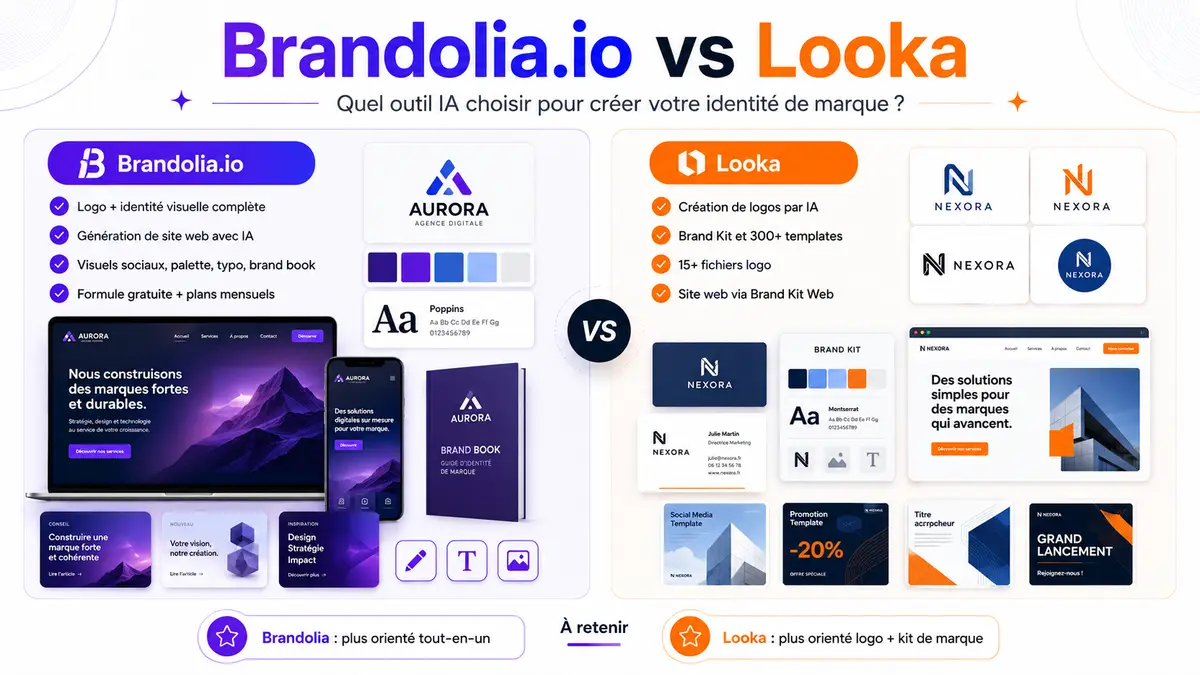
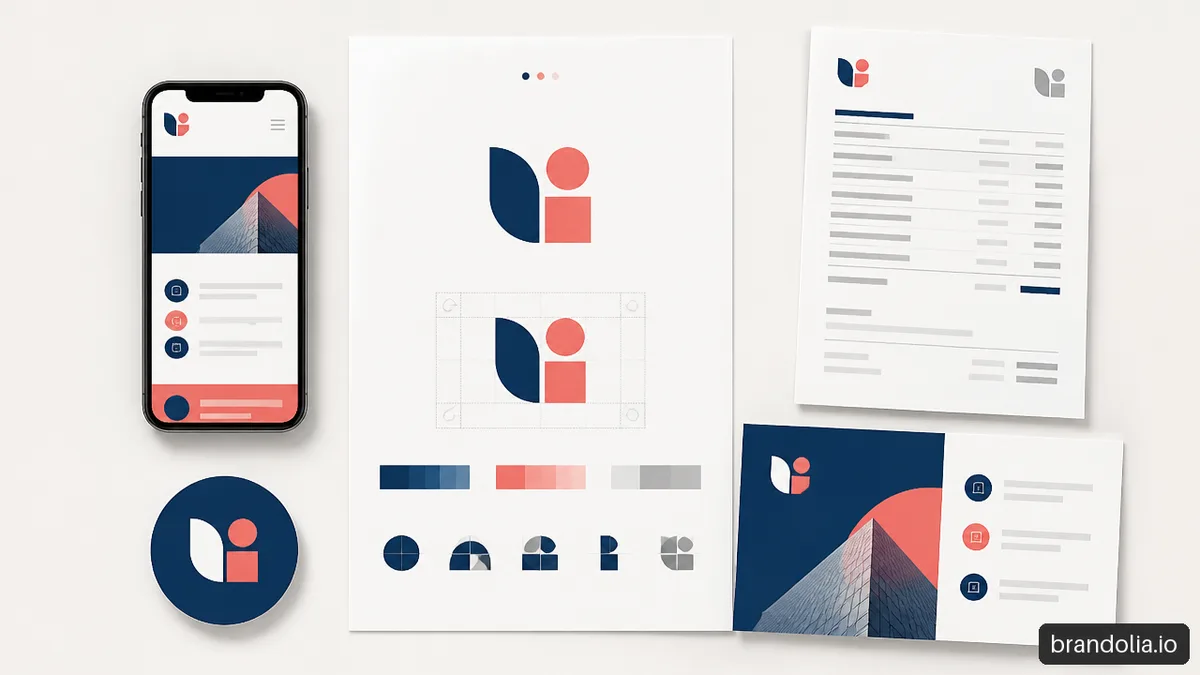
Brandolia presents itself as a platform that brings brand identity, website and marketing media. This approach may fit for a small team who wishes to limit transfers between tools. However, I advise to check the features included in the selected subscription, rather than suppose that all supplies are available everywhere.
Create and Stabilize the Brand System
Separate Exploration and Locking
Exploration opens possibilities; lock reduces variations.Mixing the two phases leads to a change of direction for each new proposal.
To learn how to create a complete brand identity with an AI without multiplying the unnecessary tests, I propose this path:
- Generate three directions based on the same brief.
- Describe for each the message and its limits.
- Keep a direction according to the criteria set in advance.
- Close the essential elements before declinations.
In the example of the consultant, an institutional track can calm but seem distant. An illustrated track can facilitate pedagogics, but appear too light on a financial document. The choice depends on the public, not on the only personal taste.
Once the direction has been selected, don’t ask an “new identity” anymore. The AI must then apply the rules, not re-invent them.
Create a re-use visual reference
A style reference must contain more than a fascinating image. It must explain what should remain stable. Amari Agency recommends a stable and documented style reference to improve the consistency of generations.
I suggest a list containing:
• The exact colors and their role: background, text, accent.
• The typographical families and the hierarchy of titles.
• The style of images: lighting, framework, materials and subjects.
• Composition rules: margins, density and location of the logo.
• Exclusions: effects, symbols or environments to avoid.
Their effect may vary depending on the models: the same description does not guarantee the same result from one service to another.
For the logo, keep a valid master file. Do not ask the image generator to re-design it in each publication: then add it to a pageing tool. This separation limits deformations and letters changes.
Connecting Your Voice to Visual Choices
Verbal identity must express the same promise as the image.A over universe associated with aggressive messages creates a breakdown that the logo repeat does not correct.
I recommend transforming each personality trait into a observable rule.
| The desire | The editorial rule | Fictional Example |
|---|---|---|
| Pedagogical | Explain the technical terms | “The cash corresponds to the money available.” |
| comforting | Presenting a clear next action | “Start by identifying your fixed expenses.” |
| Directly | Avoid abstract promises | “Please prepare your budget for the next quarter.” |
Make a commercial text and a delicate message, such as a delay ad. If the tone only works to sell, it remains incomplete. Document the accepted formulations, but also the forbidden promises and the level of familiarity.
Conducting Coherence and Rights
Testing Real Supports, Not Only Reviews
A identity is validated as a whole. A beautiful logo does not compensate for an unreadable button or an incoherent presentation. Aloha Communication recommends to test the coherence of the kit on multiple real media.
I suggest this page before publication:
| support | Test to be performed | Possible correction |
|---|---|---|
| Mobile site | Read the title and find out the main action | Adjust size, contrast and space |
| The Social Avatar | Recognize the sign in small format | Use a simplified version |
| It is printed | Check out in black and white | A monochrome version |
| Presentation | Understanding the hierarchy at distance | Reduce the density and strengthen the titles |
| Electronic Signature | Check readability and links | Avoid information only in image |
| Article long | Read several paragraphs comfortably | Adjusting police, width and interline |
For colors, check the real associations between text and background, not the isolated shades. A clear accent can work on a large surface and fail on a small button. For a major printed support, ask for a test: the screen is not enough to predict the result.
Control of meaning and distinction
A human validation remains necessary before publication. I recommend that the proposals be examined by people close to the target audience, without first explaining their intention.
Ask open questions:
• What activity do you imagine behind this brand?
• What words describe its character?
• What is difficult to understand or read?
• Does this sign remind you of an existing company?
These answers do not represent a representative study. However, they may reveal an obvious contrasens. For an international brand, check the name and slogan in the languages concerned.
If an incoherence appears, first correct the responsible rule. A repeated contrast problem calls a palette correction, not a manual repair of each publication.
Check each category of rights
Legal control must begin before the name and sign are locked.The availability of a domain does not prove that of a brand. Marie Chamfeuil distinguishes the protection of name, distinctive signs and their visual representation.
The assets differ according to the assets:
| active | Verification to be provided |
|---|---|
| name | Relevant priorities according to territories and activities |
| Logo | Similarities and conditions of protection of the signs held |
| images | Conditions of the generator and any third party elements |
| Typographs | Licence for intended uses, including web and printing |
| Textes | Reviews of formulations, facts and promises |
A commercial authorization given by a service does not guarantee, on its own, the absence of competitive rights or exclusiveness. Answers depend in particular on the territory and contractual conditions. For example, an illustration can be used in a campaign without constituting a secure distinctive sign for the main logo.
In case of important issue, make a priority search and ask for appropriate legal advice.
Create the Charter and deploy the Brand
Create a unique reference source
Your brand book should allow another person to produce a coherent support without guessing your intentions.
- The positioning and promise are validated.
- The versions of the logo and their permitted uses.
- Colors and their associations approved.
- Typographs and the rules of pageing.
- The style of the images and references used.
- The text with examples and counter-examples.
- Approved models and license information.
Add a date and a version number. Without this, an old palette may reappear in a campaign while the site already uses the news.
A useful charter does not only show what is beautiful; it explains what can change, what must remain stable and which validates the exceptions.
Organizing files and exports
For a vectorial logo, make sure it actually contains vectorial shapes: changing an extension does not transform a matrix image into exploitable tracks.
A simple organization can include:
• A modified master file.
• A document of approved exports for common use.
• A list of models ready to be personalized.
• A register of licenses and conditions preserved.
Avoid names such as “logo_final_real_final”. Prefer a convention that indicates the brand, variant, color and version. The goal is convenient: to find the right file without opening ten documents.
Distinguish Fast Production and Validation
A first kit can be generated quickly. This does not say how long the corrections or verification will be required. No reliable universal time allows to promise a successful identity in a few minutes.
I would divide the plan into three lots:
- Production of proposals.
- Strategic, technical and legal validation.
- Implementation and correction of priority supports.
A local activity with one site has fewer restrictions than a multilingual brand for multiple markets. In both cases, start with a small number of validated media. Then automatize declinations when the rules are stable enough.
Frequently Asked Questions
Start and choose your tools
How to start creating a brand identity with an AI?
Start with the audience and the promise. I advise to summarize your offer into a comprehensible phrase without a specialized vocabulary, then to specify what distinguishes it. Then ask the AI to raise the ambiguities before generating the first elements.
What IA Do I Use to Create a Professional Logo?
Choose according to the files delivered, the possibilities of retouching and the rights offered, rather than according to the only overview. A specialized generator can be used to explore; a design tool allows you to finish. First of all, check the variants necessary for your real uses.
Can we create an identity without a graphist?
Yes, for some simple projects, provided that you perform the checks described here. The help of a professional becomes relevant if the logo needs to be strongly distinctive or if the uses are complex. I would prefer a targeted validation intervention rather than publishing a poorly controlled result.
Safeguarding and Developing Your Brand
How to keep the same style on multiple visuals?
Repeat a documented reference and the same composition rules. Keep the logo out of the image generation, then add it to the final template. If the results are derived, reduce the variables instead of extending the instructions with contradictory adjectives.
Who has the rights on a logo generated by AI?
There is no single answer. Commercial use, possible protection and the absence of conflict with a third party are different questions. I recommend reading the terms of service and keeping their applicable version. For a central asset, check your situation.
How to avoid looking like a competitor?
Compare suggestions with signs already present in your industry, then do the appropriate searches before adoption. Do not ask to reproduce the style of a named brand. Instead, look for a difference related to your promise, and not just another color.
Points to retain and sources
Decisions that make the difference
To create a profitable brand, I have four priorities:
• Clear before generating : A detailed brief reduces arbitrary choices.
• Explore and lock : Declinations must apply a stable direction.
• Testing the complete system : The real media reveals the invisible defects in the insights.
• Documentation and Control : A Charter and appropriate verification make the result transmitted.
Sources and readings
- BrandingStudio.ai — How to create a complete brand identity with AI in 2026. Workflow from search and positioning to brand book and launch.
- Aloha Communication — What AI tools to choose for a consistent brand identity. Related reference in the section dedicated to multi-support tests.
- Marie-Laure Bonnaud — Branding & IA: Create a brand identity with the IA.
- Amari Agency — Create a visual identity consistent with AI. Related reference in the section dedicated to visual reference.
- Marie Chamfeuil — AI and Brand Law: How to Protect Your Identity?